_1771469451232-B6fz_cz5.png)
The landscape of construction in British Columbia is shifting beneath our feet, and it’s not just because of the rain. If you’ve spent any time on a job site in the Lower Mainland or the Fraser Valley lately, you know that the \"smash and dash\" era of demolition is quickly being replaced by the surgical precision of deconstruction. This isn’t just a trend driven by environmentalists; it’s driven by the bottom line. With Metro Vancouver and surrounding regional districts pushing for 75% waste diversion by 2026, how you load your bins can be the difference between a profitable project and a mountain of municipal fines.
At Southall Services, we’ve watched this evolution firsthand. Our January data shows a 45% surge in excavation and site prep queries, signalling that contractors are gearing up for a massive Q1. But as you plan those projects, the question isn't just how fast you can clear a lot—it’s how intelligently you can sort the debris. LEED (Leadership in Energy and Environmental Design) certification has become the gold standard for BC builds, and achieving those credits requires a documented, disciplined, and strategic waste management plan.
Understanding the Shift: Why Demolition is Dying
To the untrained eye, demolition and deconstruction look the same: things get broken down and hauled away. However, from a waste management perspective, they are polar opposites. Traditional demolition treats a building like a single unit of \"trash.\" You bring in an excavator, crush everything into a pile, and shove it into the largest available bin. This results in \"mixed waste,\" which is the most expensive category to dispose of at BC landfills due to high tipping fees and the labour required for secondary sorting.
Deconstruction, on the other hand, is the process of systematically disassembling a structure to maximize the salvage of materials. Think of it as \"construction in reverse.\" Instead of one giant bin of chaos, you have several specialized bins. One for clean wood, one for metal, one for concrete, and one for true \"garbage.\"
The LEED Factor: Credits and Compliance in 2026
For many BC contractors, LEED certification is the primary driver behind their choice of Southall’s multi-bin systems. To earn LEED points for Construction and Demolition Waste Management, you typically need to divert at least 50% to 75% of non-hazardous debris from landfills. You can’t just claim you did it; you need the weight tickets to prove it.
This is where strategic bin loading becomes your best friend. When you mix materials, the landfill or transfer station classifies the entire load based on its most difficult-to-process component. If you have a 20-yard bin filled with 90% clean lumber but you toss in a few rolls of old carpet and some insulation, that entire load is now \"mixed C&D\" (Construction and Demolition) waste. You’ll pay the highest premium for that weight. By isolating materials into dedicated Southall bins, you aren't just earning LEED credits; you're significantly lowering your tipping fee overhead.
The \"Clean Wood\" Catch
In British Columbia, \"clean wood\" (unpainted, untreated, no glue/laminate) is often accepted at a fraction of the cost of mixed waste. However, even a small amount of \"dirty\" wood or plastic in the bin can trigger a reclassification of the entire load. Always keep a dedicated 10-yard bin specifically for clean lumber to maximize your savings.
The Economics of Multiple Bins
There is a common misconception that renting three 10-yard bins is more expensive than renting one 40-yard bin. On the surface, the delivery fees might suggest that, but the math changes the moment you hit the scale.
In 2026, regional landfill rates have become increasingly granular. Separating heavy materials such as concrete and masonry into separate bins is essential. Concrete is incredibly heavy but highly recyclable. If you mix concrete with lighter household debris, the sheer weight will skyrocket your \"mixed waste\" bill. If you put that concrete into a dedicated Southall rock bin, it goes to a crushing facility where the tipping fee is significantly lower. This \"diversion at the source\" is the cornerstone of a circular economy.
By utilizing a multi-bin strategy, you protect your project from the volatility of mixed-waste pricing. You know exactly what’s in each bin, and you know exactly which facility it’s headed to.
Strategic Loading: The "Tetris" of Waste Management
How you physically load a bin matters just as much as what you put in it. Professional deconstruction crews treat bin loading like a game of Tetris. To maintain efficiency and safety, you should always start with your heaviest, flattest materials at the bottom.
By loading strategically, you can often fit 20% to 30% more material into the same footprint, reducing the total number of hauls needed. This aligns with our goal of \"efficiency and conversion\" for our clients. Fewer hauls mean a lower carbon footprint for your project and more money left in your budget.
Navigating the "Wet Weight" Trap
February in British Columbia is notoriously damp; managing the \"seasonal regression\" of certain services requires awareness of environmental factors. For bin rentals, the biggest environmental factor is rain.
Drywall, wood, and even old carpeting act like giant sponges. If your bin sits open during a week of heavy rain, you could be adding hundreds of pounds of \"water weight\" to your load. Since landfills charge by the tonne, you are essentially paying the government to dispose of rainwater. We always recommend that our deconstruction partners keep their bins covered with heavy-duty tarps when not in use. This simple step can save a contractor thousands of dollars on a large-scale LEED project.
Safety Tip: Weight Distribution
When loading bins for hauling (especially for our dump truck services), always try to center the weight over the rails. An unbalanced bin is a hazard during the \"roll-off\" process and can cause unnecessary wear on your driveway or the job site surface.
The Role of Southall in Your LEED Strategy
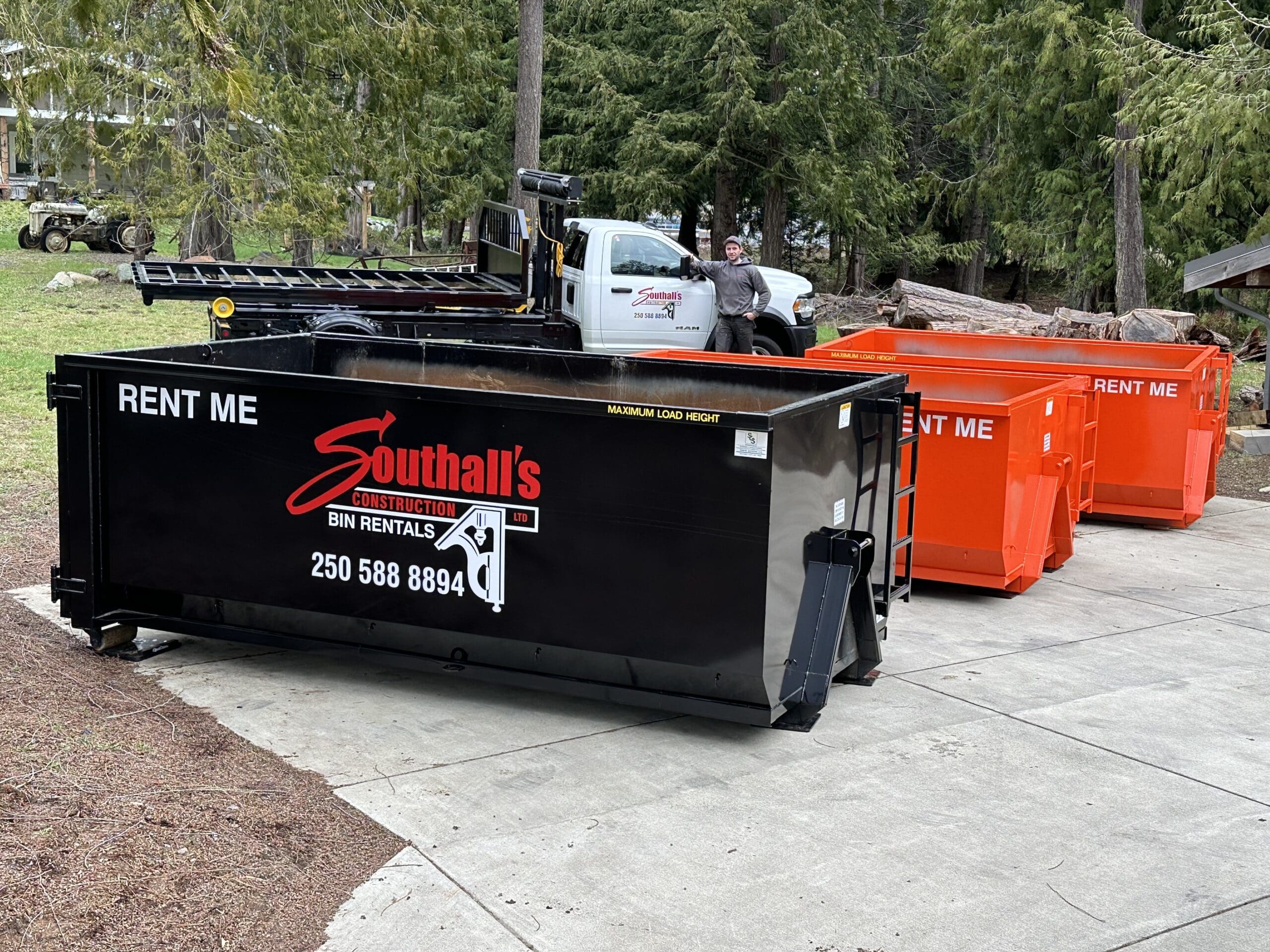
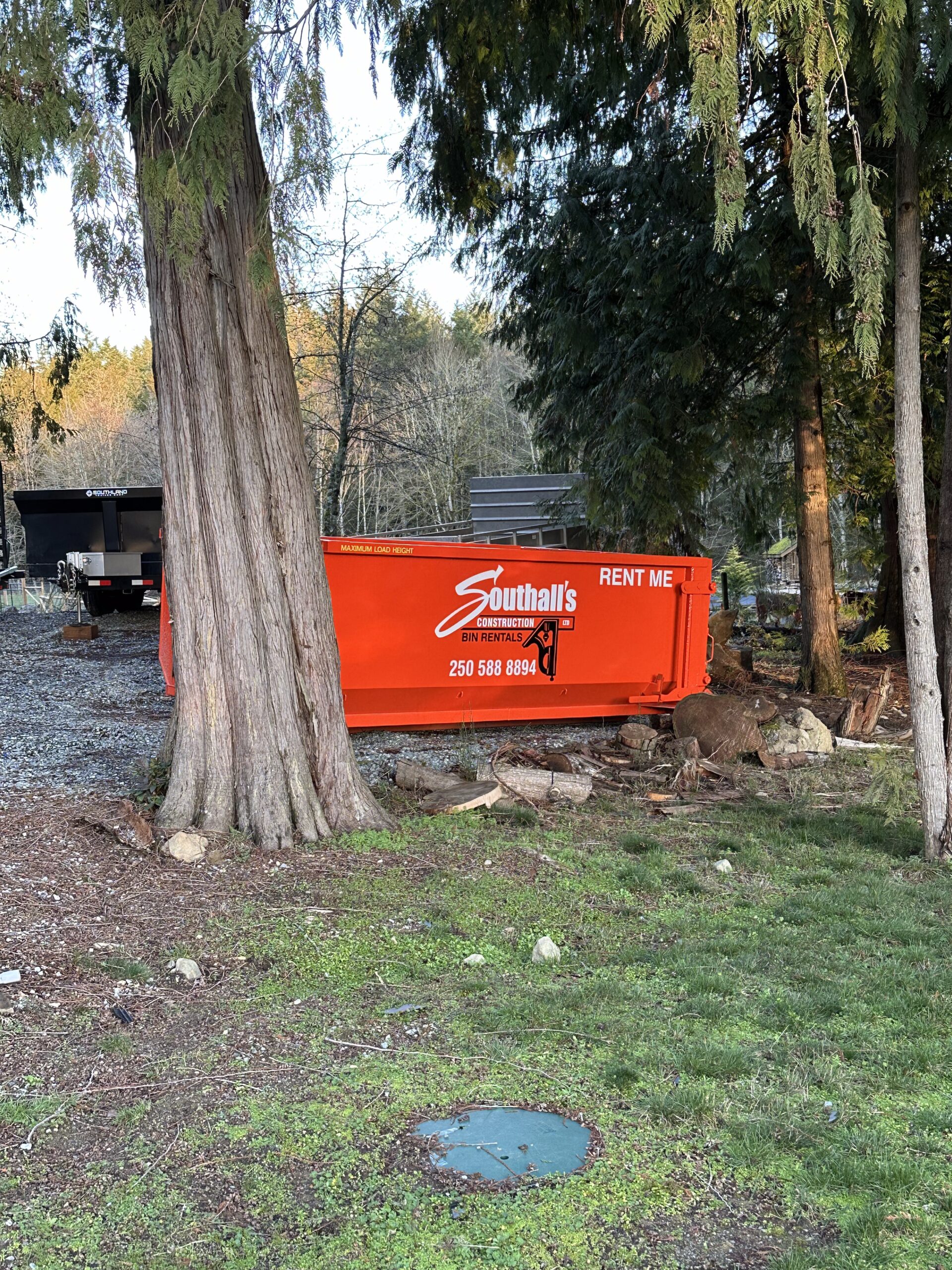
We don't just drop off bins; we act as the logistical backbone of your waste management plan. When you partner with Southall, we can help coordinate the timing of your \"hauls\" to match your deconstruction phases. For example, we might provide a fleet of smaller 12-yard bins during the initial \"soft strip\" of a building (removing fixtures, appliances, and metals) and then swap them for heavy-duty rock bins once the structural disassembly begins. This phased approach keeps your job site organized and ensures that materials are diverted to the correct facilities in real-time.
Final Thoughts on the Circular Economy
The \"circular economy\" isn't a destination; it's a practice. It’s the choice to see a pile of old cedar siding not as trash, but as a resource. It’s the decision to spend an extra hour sorting metal from wood to save $400 on a tipping fee. And it’s the commitment to using a local BC hauler like Southall Services that prioritizes transparency and reliability over national aggregator convenience.
As we move through February and into the busy spring season, remember that your waste management plan is one of the most visible parts of your project's professionality. A clean, well-sorted site isn't just good for the environment—it’s a signal to your clients and the municipality that you are a top-tier operator.
Frequently Asked Questions
Need Help With Your Project?
Contact Southall Services for professional bin rentals, excavation, and hauling in the Cowichan Valley.